
Recreational bettors frequently view the Halftime/Fulltime (HT/FT) market as a lottery ticket—a nine-outcome matrix dominated by rare, high-paying reversals like Home/Away (1/2) or Away/Home (2/1) priced at 25.00 or higher. Because standard match-result (1X2) markets distribute liquidity across three outcomes, expanding to nine distinct permutations increases variance and bookmaker overround (vig).
However, executing a structured halftime fulltime betting strategy does not rely on guessing improbable comebacks. By analyzing temporal goal-scoring distributions, first-half tactical conservation, and asymmetric hedging protocols, quantitative bettors isolate mispriced mid-tier combinations—specifically Draw/Favorite (X/1 or X/2)—to capture elevated payouts without exposing their bankrolls to extreme variance.
Decoding the 9-Outcome Matrix: Bookmaker Vig vs. True Probability
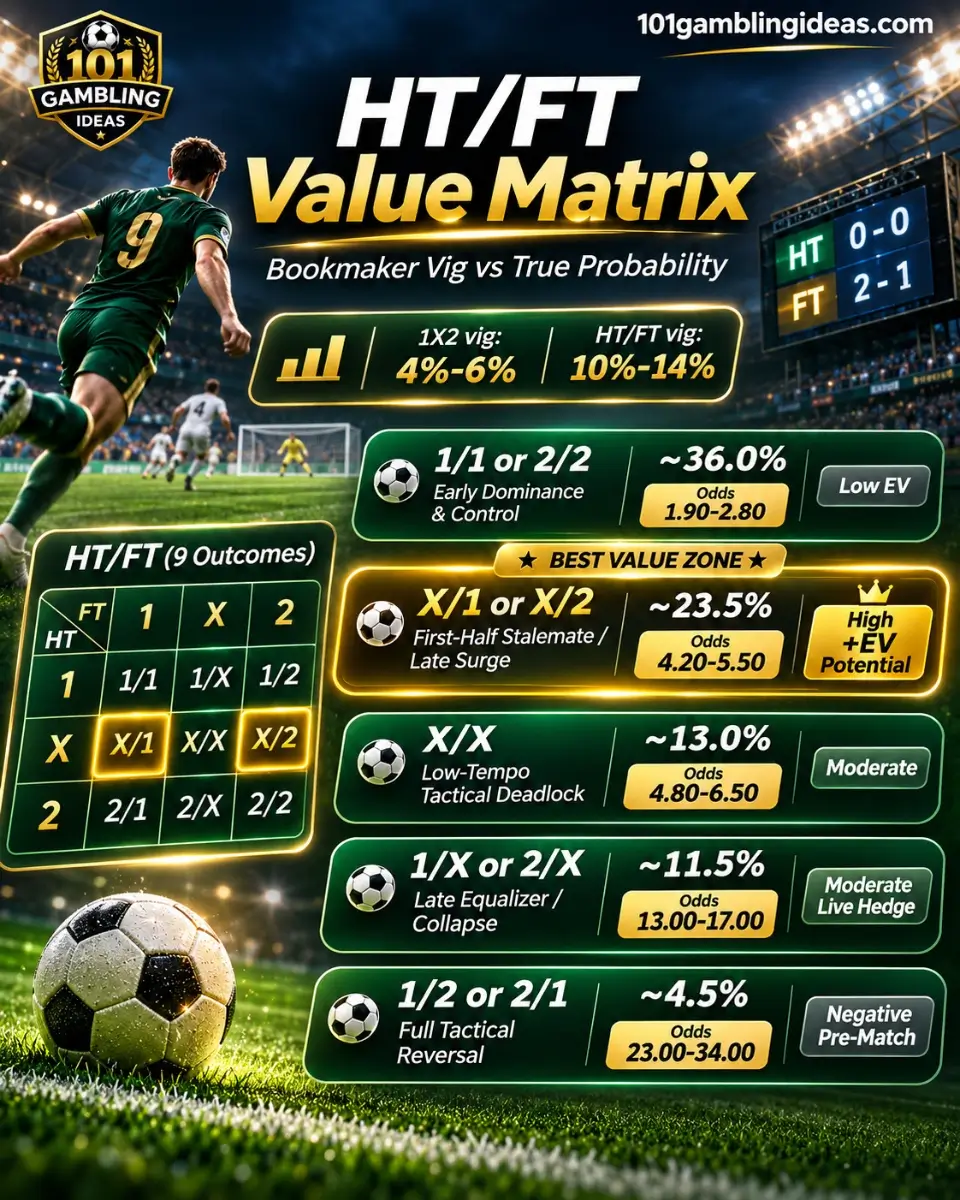
The HT/FT market requires predicting the exact match state at the 45-minute mark and at the final whistle. While standard 1X2 lines typically carry a bookmaker margin of 4% to 6%, HT/FT markets often carry an embedded vig between 10% and 14%. Sportsbooks inflate this margin because casual bettors over-index on long-shot reversals, ignoring the true underlying conditional probabilities.
Understanding halftime betting market mechanics requires separating the nine outcomes into three structural tiers based on historical league data:
| HT/FT Outcome | Tactical Profile | Historical Frequency (Top 5 Leagues) | Typical Odds Range | True Expected Value (+EV) Potential |
|---|---|---|---|---|
| 1/1 or 2/2 | Early Dominance & Control | ~36.0% | 1.90 – 2.80 | Low (Heavily Taxed by Vig) |
| X/1 or X/2 | First-Half Stalemate / Late Surge | ~23.5% | 4.20 – 5.50 | High (Undervalued by Public) |
| X/X | Low-Tempo Tactical Deadlock | ~13.0% | 4.80 – 6.50 | Moderate (League Dependent) |
| 1/X or 2/X | Late Equalizer / Game State Collapse | ~11.5% | 13.00 – 17.00 | Moderate (Live Hedge Target) |
| 1/2 or 2/1 | Full Tactical Reversal | ~4.5% | 23.00 – 34.00 | Negative Pre-Match (High Vig Trap) |
Backing a heavy favorite on the standard 1X2 line at 1.45 offers minimal capital growth. Backing that same favorite via the Draw/Favorite (X/1) line routinely yields odds between 4.30 and 5.00—more than tripling the return while aligning with how modern elite teams break down compact defensive blocks.
Temporal Goal Distributions: The Draw/Favorite (X/1) Edge
Modern football exhibits a pronounced second-half scoring skew. In top European domestic competitions, roughly 56% to 58% of all goals are scored after the 45th minute. During the opening half, underdog teams maintain peak physical stamina and strict organizational discipline, frequently absorbing pressure to reach the interval at 0-0.
To quantify the exact edge of an X/1 entry, evaluate the conditional probability equation:
P(X/1) = P(HT Draw) × P(Home Win | HT Draw)
Multiply the probability of a first-half draw by the conditional probability of the home side winning after a level opening half.
When a dominant home side averages 2.10 Expected Goals (xG) per match but concedes less than 0.35 xG in the first 30 minutes, bookmakers often underprice the 1/1 line due to public money while leaving the X/1 line inflated.
Deploying a high odds football strategy around X/1 selections targets specific team archetypes:
- High-Possession Controllers: Teams that systematically tire opponents through lateral ball circulation in the first half before introducing high-pace wingers at the 60th minute.
- Low-Block Visitors: Away underdogs that prioritize compact defensive shape until half-time, rarely committing numbers forward on counter-attacks during the opening 45 minutes.
- Slow-Starting Favorites: Clubs exhibiting a historical disparity where over 65% of their total season goals occur in the second half.
Comeback Mechanics: Filtering for True Reversal Catalysts
While blind pre-match wagers on 1/2 or 2/1 reversals bleed capital due to excessive vig, targeted conditional reversals offer legitimate mathematical value when filtered through strict quantitative criteria. Building an effective ht ft comeback prediction system requires identifying structural mismatches between first-half variance and second-half tactical adjustments.
Monitor these three specific catalysts before allocating fractional capital to reversal lines:
- Asymmetric Bench Depth: Elite clubs competing in congested fixture schedules frequently rotate key attackers out of the starting XI, deploying them from the bench at halftime or the 60th minute if the team falls behind.
- Early Variance Deficits: Teams with strong underlying defensive metrics that concede early due to low-probability events (e.g., an early penalty, deflected long-range strike, or goalkeeper error) possess a significantly higher second-half recovery rate than teams conceding via systemic defensive breakdown.
- In-Game Tactical Shifts: Managers who aggressively abandon conservative back-five formations for high-pressing four-attacker setups when trailing at halftime dramatically elevate second-half Expected Goals (xG) output.
Asymmetric Risk Control: Hedging HT/FT Wagers In-Play
The primary advantage of holding a pre-match HT/FT ticket is the option to lock in guaranteed profit or eliminate downside risk at the 45-minute mark. Because the first leg of the wager resolves at halftime, live liquidity surges during the 15-minute break, creating clean trading windows.
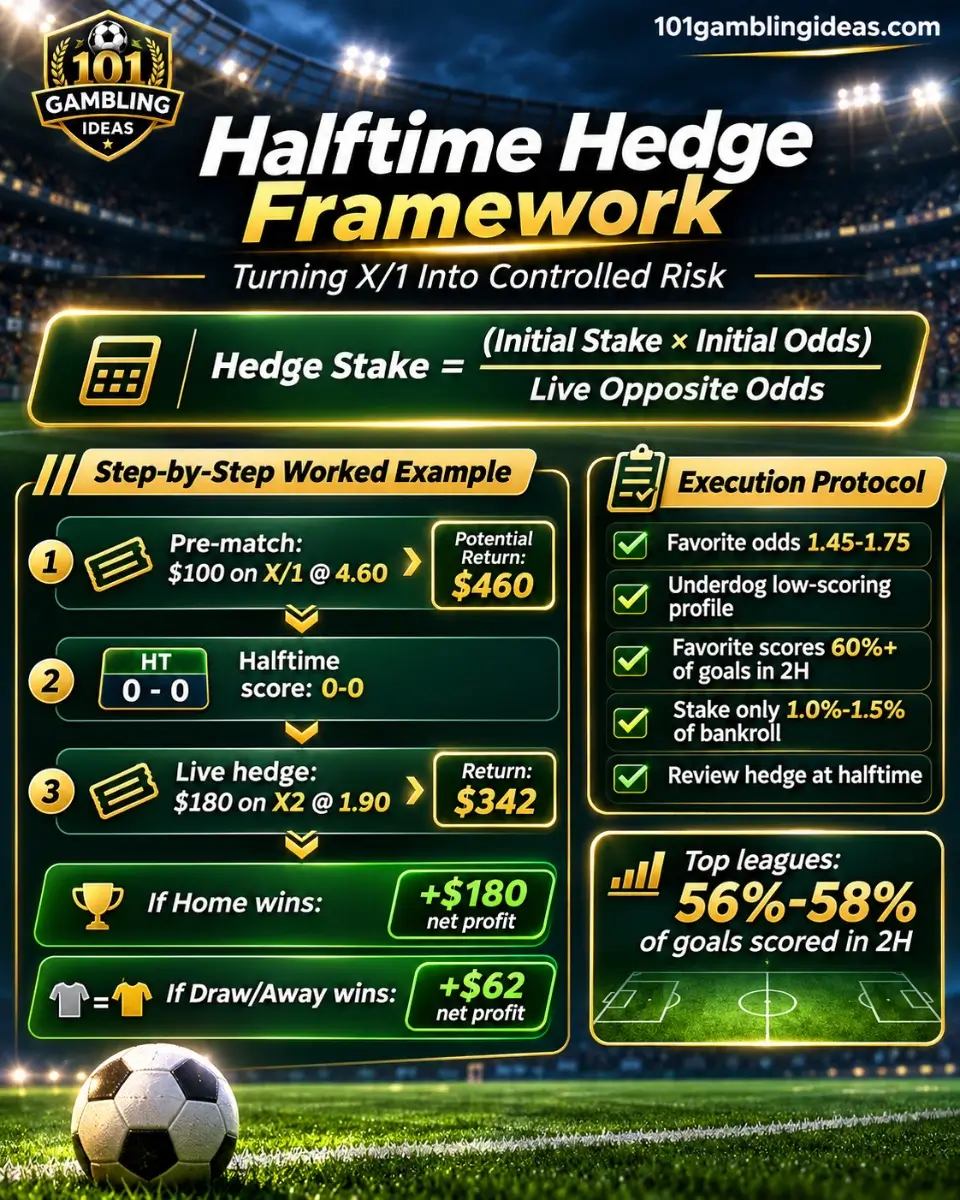
Mastering hedging ht ft wagers follows a straightforward mathematical lock-in formula:
Hedge Stake = (Initial Stake × Initial HT/FT Odds) ÷ Live Opposite Market Odds
Calculate the required live hedge stake once the opening half settles in your favor to balance returns across remaining outcomes.
Consider a practical execution scenario: you place $100 on Draw/Home (X/1) at pre-match odds of 4.60 (potential return: $460). The first half ends 0-0, successfully clearing the Draw leg. At halftime, the live Asian Handicap or 1X2 market prices the Home Win at 1.95, while Away/Draw (Double Chance X2) is priced at 1.90.
By placing $180 on the live X2 Double Chance at 1.90 ($342 return), you create an asymmetric risk-free position:
- If Home Wins in the Second Half: You collect $460 from the original X/1 ticket minus $280 total outlay ($100 + $180) = +$180 net profit.
- If the Match Ends in a Draw or Away Win: You collect $342 from the live X2 hedge minus $280 total outlay = +$62 net profit.
This systematic approach transforms a high-variance pre-match ticket into a guaranteed positive return regardless of second-half variance.
101GamblingIdeas Sports Analytics Hub
Explore our connected football modeling guides and sportsbook breakdowns on 101GamblingIdeas to refine your match pricing and live execution:
- Over/Under 2.5 Goals Analytics: Exploiting Live Betting xG Models
- Corner Betting Micro-Markets: Data-Driven Strategies for Live Football Lines
- Asian Handicap Plus Strategy & Line Mechanics
- Prediksi Bola: Myths & Facts for Accurate Forecasts
- Common Mistakes to Avoid in Football Betting
- Strategies for Successful Mix Parlay Betting
- 2026 World Cup Betting Guide: Pro Strategies
- Saba Sports Review & Live Market Coverage
Execution Protocol for HT/FT Markets
To isolate value and maintain strict bankroll discipline in high-odds markets, execute every position using this five-step checklist:
- Fixture Screening: Filter for matches featuring a strong pre-match favorite (1X2 odds between 1.45 and 1.75) facing a disciplined, low-scoring underdog.
- Temporal Split Audit: Verify that the favorite scores at least 60% of their goals in the second half while the underdog concedes fewer than 0.60 goals per first half.
- Line Shopping: Compare the X/1 or X/2 odds across multiple sportsbooks to ensure you capture a minimum price threshold of 4.20 or higher.
- Fractional Sizing: Cap pre-match HT/FT stake allocation at 1.0% to 1.5% of your total bankroll to absorb first-half goal variance.
- Halftime Hedge Evaluation: If the first half finishes level (0-0 or 1-1), calculate the live Double Chance hedge immediately during the interval to lock in asymmetric profit.