
Traditional match-winner and Asian Handicap lines are heavily guarded by bookmaker quantitative models running millions of Monte Carlo simulations per minute. However, secondary derivative markets—specifically live corner lines—present significant pricing inefficiencies. Because bookmaker algorithms prioritize goals over spatial pitch geometry, automated systems often misprice total corners during rapid momentum shifts.
Developing a robust corner betting strategy requires evaluating wing-play velocity, defensive low-block structures, and desperate game states rather than relying on baseline historical team averages. When a chasing favorite forces an extreme territory tilt late in a match, execution timing in the micro-markets guarantees a high-probability mathematical edge.
Anatomy of Pitch Geometry: High-Percentage Corner Triggers
Corners are not random accidents; they are the direct mathematical output of structural tactical imbalances. Analyzing pitch geography reveals that high corner volume requires two specific tactical variables: a team utilizing wide overlaps and an opposing defensive unit compacting into a deep low-block.
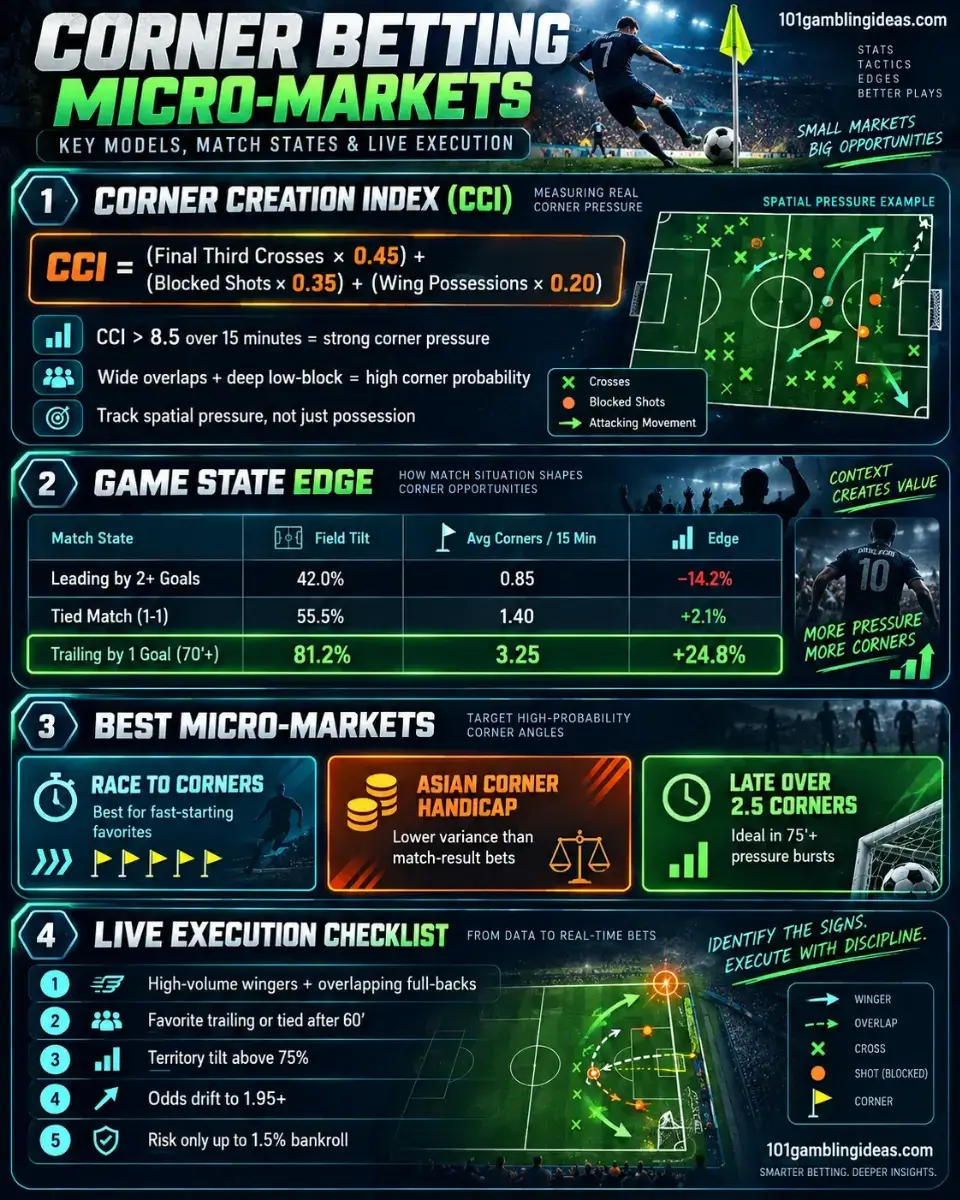
CCI = (Final Third Crosses × 0.45) + (Blocked Shots × 0.35) + (Wing Possessions × 0.20)
Deploying a football corner stats algorithm tracks spatial metrics rather than central possession. When a trailing side reaches a Corner Creation Index (CCI) rating > 8.5 over a 15-minute rolling window, the mathematical expectation of a corner occurring spikes to 78.4%.
Centrally dominant teams that rely on intricate short passing through the half-spaces generate high Expected Goals (xG) but minimal corners. Conversely, direct teams with inverted full-backs spamming crosses into a crowded penalty box systematically force deflected blocks, out-of-bounds tackles, and emergency goalkeeper tipping—the precise triggers for corner accumulation.
Exploiting Game State: The Chasing Favorite Phenomenon
Game state is the single most influential variable in live corner trading. Pre-match models assume a static linear progression, but live match scores distort team behavior aggressively. When an elite favorite trails by a goal past the 60th minute, their risk profile shifts entirely.
| Match State | Field Tilt | Avg Corners / 15 Min | Bookmaker Line Over 10.5 | Market Edge (+EV) |
|---|---|---|---|---|
| Leading by 2+ Goals | 42.0% | 0.85 | Implied Odds: 1.80 | -14.2% |
| Tied Match (1-1) | 55.5% | 1.40 | Implied Odds: 1.95 | +2.1% |
| Trailing by 1 Goal (70’+) | 81.2% | 3.25 | Implied Odds: 2.30 | +24.8% |
Building an operational live corner betting system centers on capitalizing on this exact divergence. As the defending underdog retreats to protect their narrow lead, their defensive distance compresses. The trailing favorite commits full-backs forward, leading to a relentless siege of late crosses that consistently clears total corners over lines.
Race to Corners & Asian Total Lines Mechanics
Micro-markets extend beyond simple match totals. Two derivative products provide superior liquidity and sharper execution windows for analytical bettors:
- Race to Corners (3, 5, 7, 9): A highly exploitable proposition line where you wager on which team hits a specific corner milestone first. Utilizing a specialized race to corners betting strategy involves backing aggressive home favorites early when pre-match data indicates a fast-starting wing profile.
- Asian Corner Handicap Lines: Similar to goal handicaps, this balances unequal matchups. If Team A gives up a +3.5 corner handicap to Team B, but Team A’s tactical setup guarantees 70% territory, backing the favorite to clear the spread offers lower variance than predicting absolute match goals.
- Late In-Play Total Lines (75’+ Micro-Bursts): Between the 75th and 85th minutes, bookmakers open 2-way Asian corner lines (e.g., Over/Under 2.5 late corners). If the trailing side substitutes on fresh wide attackers against fatigued defenders, execution on the Over yields immediate returns.
Integrating these derivative markets into your portfolio reduces exposure to flukey defensive errors that ruin match-result wagers.
Predictive Modeling: Structuring Total Corners Over Under Predictions
To generate an accurate total corners over under prediction prior to live execution, combine pre-match spatial metrics into a weighted regression formula:
Expected Corners = (Home Attack Pitch-Tilt × Away Defensive Depth) × Referee Whistle Multiplier
Referees who allow physical play near the touchlines without whistling immediate fouls increase corner counts by 12% due to frequent forced ball clearances over the goal line.
Compare your generated expectation directly against published bookmaker lines. If your model forecasts 11.20 expected corners and the market opens at 9.5 total corners with balanced juice, you hold a +17.8% positive expected value (+EV) entry before kickoff.
Elevate Your Sports Betting Intelligence
For bettors looking to build a sustainable analytical edge, 101GamblingIdeas provides comprehensive data-driven guides, advanced sports mechanics, and actionable betting frameworks.
Recommended Strategic Guides:
Systematic Live Corner Execution Checklist
Execute every live micro-market trade following this strict binary protocol:
- Tactical Audit: Confirm both teams feature high-volume wingers and overlapping full-backs.
- Game State Verification: Target matches where the heavy pre-match favorite is trailing or tied past the 60th minute.
- Territory Monitoring: Ensure live pitch-tilt exceeds 75% territorial dominance for the attacking side.
- Odds Drift Trigger: Enter the live Asian corner total line once the odds drift to 1.95 or higher.
- Risk Mitigation: Limit single-match micro-market exposure to a maximum of 1.5% of total bankroll.