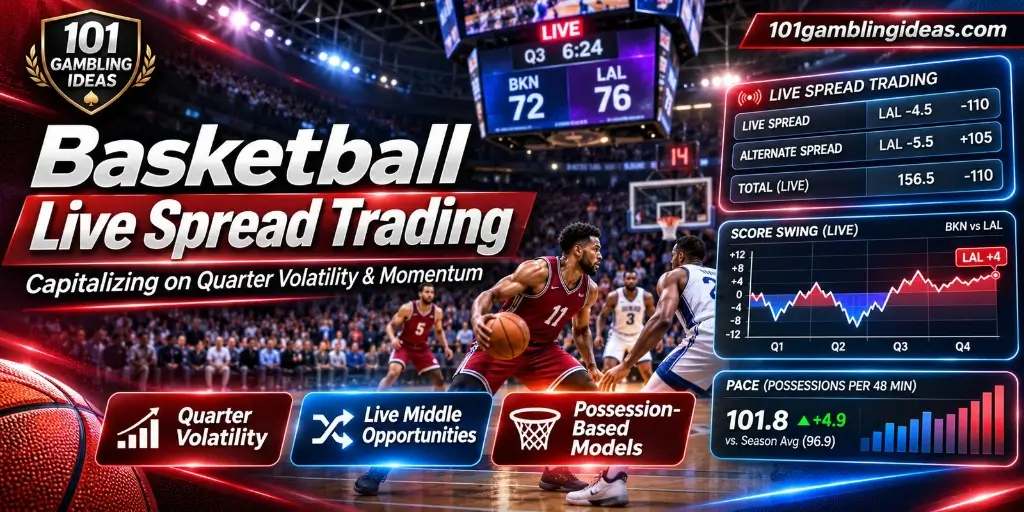
Basketball presents one of the highest-scoring, fastest-moving environments in global sports betting. Unlike low-scoring football matches where a single goal alters the entire probability curve, an NBA or EuroLeague game features roughly 190 to 210 combined possessions. Because scoring occurs every 14 to 24 seconds, short-term shooting variance produces dramatic scoreboard swings that distort live point spreads.
Executing a disciplined basketball live spread strategy relies on separating temporary three-point shooting variance from structural efficiency. When a pre-game favorite falls behind by 14 points in the second quarter due to cold perimeter shooting rather than defensive collapse, automated sportsbook algorithms over-adjust the live spread. Entering the market during these peak momentum distortions allows sharp traders to capture middle opportunities and positive expected value (+EV) lines.
Possession-Based Modeling: Pace, Offensive Rating, and True Margin
Pre-game point spreads are derived from two primary metrics: Pace (possessions per 48 minutes) and Net Rating (point differential per 100 possessions). While recreational bettors focus on raw scoreboard totals, quantitative traders evaluate live efficiency on a per-possession basis.
To calculate the projected true margin during active play, apply the pace-adjusted efficiency formula:
Projected Live Margin = Current Margin + [(Remaining Possessions ÷ 100) × (Team A Net Rating – Team B Net Rating)]
Combine the current scoreboard differential with expected per-possession outperformance across the remaining possessions in regulation.
Understanding possession based sports betting exposes why raw score deficits can be misleading. In modern NBA basketball, teams routinely attempt 35 to 45 three-point shots per game. If a team with a +6.5 Net Rating shoots 2-for-16 from beyond the arc in the first quarter while generating high-quality open looks, their scoreboard deficit reflects normal statistical variance rather than inferior execution.
Bookmaker algorithms adjust live lines using both real-time score and time decay. When an underdog rides an unsustainable 75% three-point shooting burst in the opening quarter, nba live betting algorithms shift the live spread aggressively toward the underdog, creating an immediate mathematical discount on the trailing favorite.
Quarter Volatility Mechanics: Identifying Mean-Reversion Windows
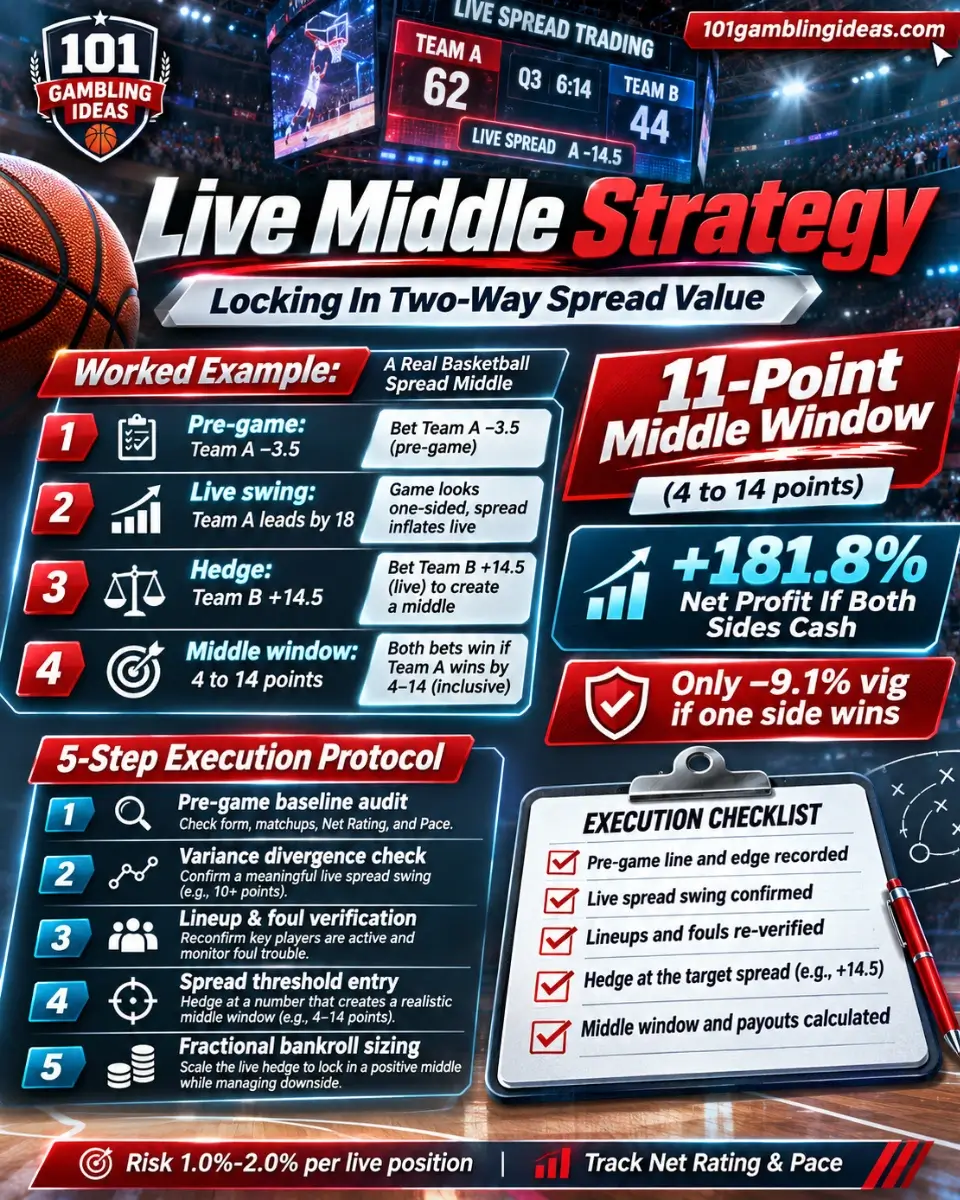
Professional basketball games rarely progress linearly. Coaching rotations, foul trouble, and bench unit mismatches create distinct scoring runs across all four quarters. Tracking historical quarter volatility reveals predictable mean-reversion windows where live lines reach maximum distortion.
| Game Segment | Primary Variance Catalyst | Algorithm Pricing Behavior | Optimal Live Trading Action |
|---|---|---|---|
| Late Q1 / Early Q2 | Bench Unit Rotations & Cold Shooting | Overreacts to early 10–14 pt runs | Back trailing pre-game favorite on live spread |
| Halftime Interval | Tactical Adjustments & Rested Starters | High liquidity; sharp money resets lines | Target 2H (Second Half) spreads on elite coaching teams |
| Mid-Q3 (Third Quarter Surge) | Defensive Intensity & Turnover Spikes | Lags behind sudden pace acceleration | Trade live momentum runs before timeouts reset lines |
| Final 4 Minutes (Q4) | Intentional Fouling & Free-Throw Variance | Wide spreads; heavy vig on moneyline | Avoid full-game spreads; target live totals only |
Applying quarter momentum betting basketball principles requires monitoring the exact transition between starter and bench lineups. When a dominant starting five exits at the 4-minute mark of the first quarter and the second unit surrenders a 12-2 run, the live spread shifts by 4 to 6 points. Entering just before the starters re-enter the floor in the second quarter captures immediate positive line movement.
Micro-Triggers: Foul Trouble, Timeouts, and Shot Quality
Profitable in play basketball spread trading demands tracking granular box-score telemetry rather than watching the scoreboard alone. Before executing a live spread position, verify these three operational triggers:
- Rim Frequency vs. Perimeter Variance: Audit the shot chart distribution. If the trailing favorite is attacking the paint, drawing fouls, and generating layups but missing open perimeter jumpers, regression to the mean will naturally close the gap. Avoid backing trailing teams settling for contested mid-range shots.
- Key Rim-Protector Foul Trouble: When an elite defensive center picks up two fouls in the first quarter or three fouls before halftime, the team’s defensive rating drops by 6 to 9 points per 100 possessions. Trade against that team’s live spread immediately while the backup center is forced into extended minutes.
- Timeout Momentum Resets: Elite coaches call timeouts specifically to halt opponent 8-0 or 10-0 scoring runs and draw up high-efficiency after-timeout (ATO) sets. Placing a live spread wager on the trailing team during the commercial break—before the ATO play executes—secures the peak distressed price.
Executing the Live Middle: Locking In Two-Way Spread Profits
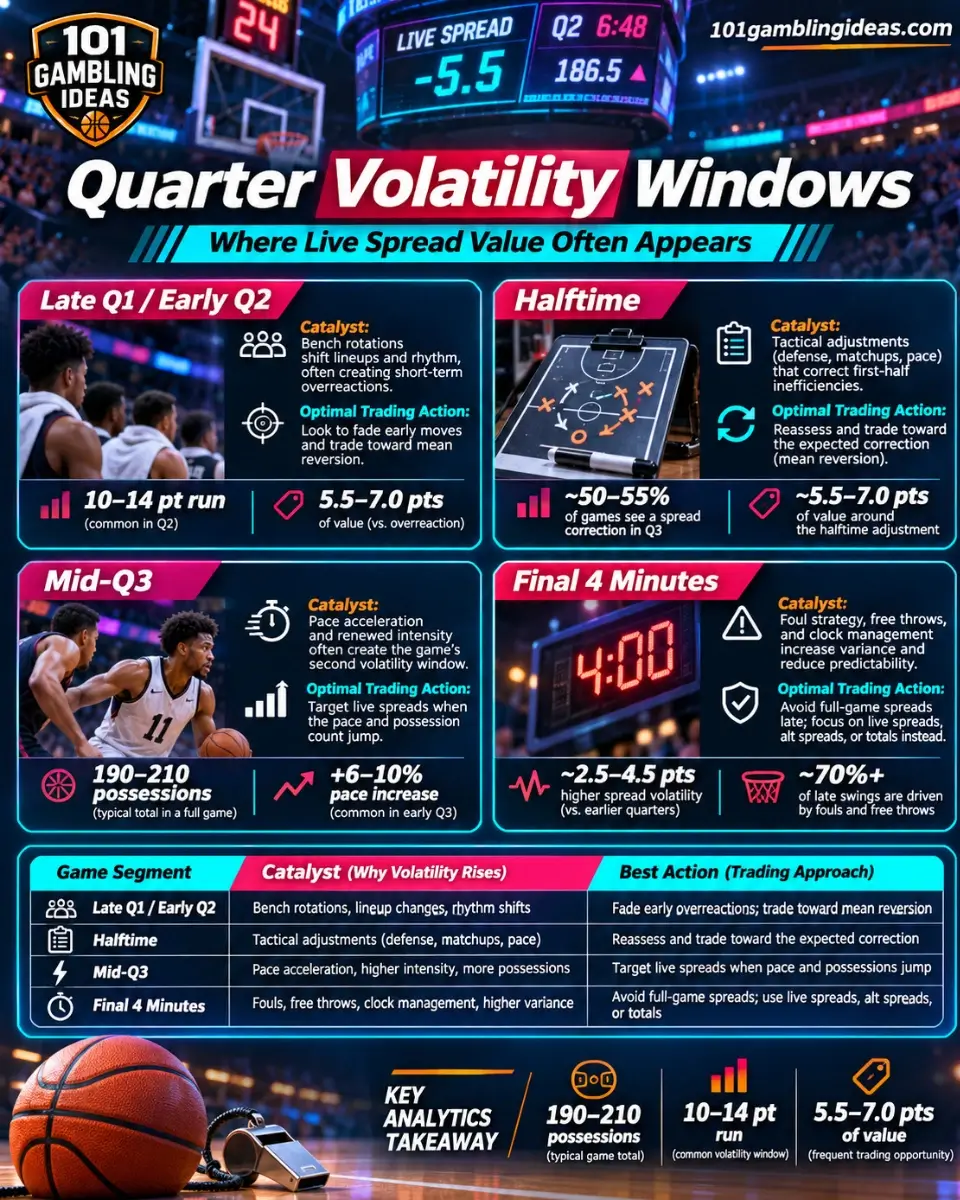
One of the highest-yielding techniques in basketball trading is “middling”—holding both sides of a point spread at different numbers so both tickets can cash simultaneously if the final margin lands inside the gap.
Consider a standard execution sequence:
- Pre-Game Entry: You back Team A at -3.5 (-110) before tip-off based on superior Net Rating.
- In-Play Surge: Team A dominates the first half, building an 18-point lead. Live algorithms push Team A’s live spread to -14.5, pricing Team B at +14.5 (-110).
- Live Hedge / Middle Entry: You place an equal stake on Team B +14.5 (-110).
This creates an 11-point middle window (margins between 4 and 14 points):
- If Team A Wins by 4 to 14 Points: Both tickets win simultaneously, yielding +181.8% net profit on a single unit risk.
- If Team A Wins by 15+ or Less Than 4: One ticket wins and one loses, costing only the -9.1% vig insurance fee.
By targeting volatile, fast-paced matchups with high three-point volume, traders generate frequent 8-to-12-point middle corridors with minimal downside exposure.
101GamblingIdeas Sports Analytics Hub
Explore our connected quantitative betting guides and sportsbook breakdowns on 101GamblingIdeas to refine your market pricing and live execution:
- Asian Handicap Plus Strategy & Line Mechanics
- Over/Under 2.5 Goals Analytics: Exploiting Live Betting xG Models
- Corner Betting Micro-Markets: Data-Driven Strategies for Live Football Lines
- Halftime/Fulltime (HT/FT) Betting Mechanics: Risk Management for High-Odds Markets
- Strategies for Successful Mix Parlay Betting
- Saba Sports Review & Live Market Coverage
- W88 Sportsbook Review & Live Odds Liquidity
Systematic Basketball Spread Trading Protocol
To maintain mathematical discipline across an 82-game NBA season or international tournament schedule, follow this five-step execution protocol:
- Pre-Game Baseline Audit: Record the pre-game closing spread, total, and each team’s season Net Rating before tip-off.
- Variance Divergence Check: Monitor Q1 and Q2 for 10+ point deficits driven by three-point shooting disparities (e.g., Team A shooting under 22% from three while Team B shoots over 50%).
- Lineup & Foul Verification: Confirm that the trailing favorite’s primary playmaker and rim protector are active and free of severe foul trouble.
- Spread Threshold Entry: Execute the live spread wager once you capture at least 5.5 to 7.0 points of value compared to the pre-game closing line.
- Fractional Bankroll Sizing: Risk 1.0% to 2.0% per live spread position, reserving capital to execute live middles if the game swings violently in your favor.